


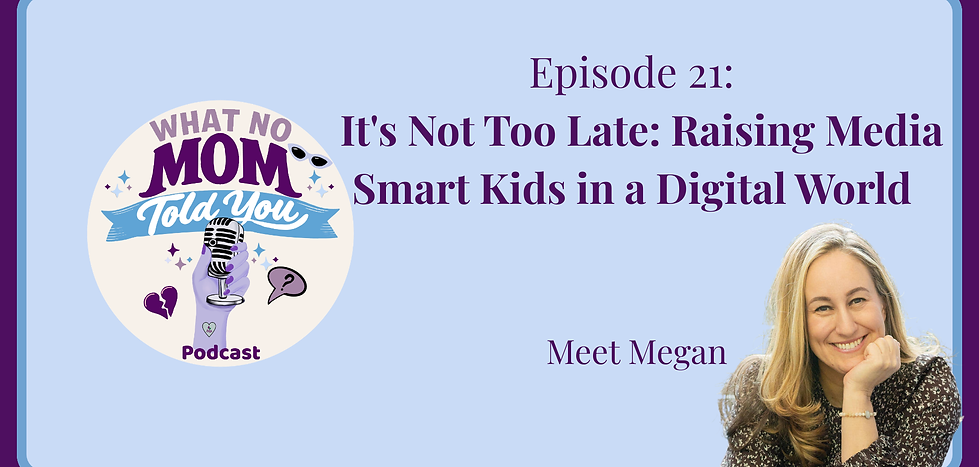
Episode
21
It's Not Too Late: Raising Media Smart Kids in a Digital World
June 9, 2026
Share this page

Pauline Walfisch
Psychotherapist, LCSW, PMH-C

Megan Nelson
Psychotherapist, LMSW

Megan Kiefer
Entrepreneur and Educator
Description
Megan Kiefer has dedicated over 16 years to transforming education through media literacy and responsible content creation. As the founder of Take Two Media Initiative and Take Two Film Academy, she has been at the forefront of teaching filmmaking and media consumption to students ranging from toddlers to young adults. Her unique approach emphasizes the importance of understanding the media's impact, not just in classrooms but in everyday life.
We are so excited to have Megan on the What No Mom Told You podcast! She is here to offer practical advice for parents struggling with the endless loops of TikTok and YouTube. Megan also discusses her latest book, “The Take Back,” which provides a roadmap for helping our children regain their focus and develop essential digital literacy skills that will serve them for a lifetime.
Resources
Topics
Mental Health, Parenting, Advocacy, Community & Support
Transcripts
Pauline (00:09.341)
I'm Pauline Walfisch and I'm excited to be here with you today. Joined by my co-host, Megan Nelson.
Megan (00:29.661)
Hi everyone.
Today is our second round of Pauline Between Two Megans. So I think we're gonna make this a regular thing. Maybe we only have Megan guests on, but today our guest is Megan Kiefer. She is the founder of Take Two Media Initiative and Take Two Film Academy. Megan is an entrepreneur and an educator dedicated to transforming education and the world through media literacy and responsible
content creation. So welcome.
Megan Kiefer (01:04.823)
Thank you for having me. This is so fun. I really appreciate it.
Megan (01:07.591)
Thank you. Yeah, thank you for being here. can you describe first to start off, can you describe what Take Two Media Initiative is?
Megan Kiefer (01:18.926)
So,
So I started, I guess maybe I'll give you like a two minute how it all kinda came to be. So I started Take Two Film Academy 16 years ago, and this was before YouTube, before anyone could be a content creator. We were really teaching the craft of filmmaking. And over the course of the last 16 years, obviously the technology's changed and grown, and pretty much everyone right now is a content creator or media creator. we've really kind of taken the craft
filmmaking, we still really, you know, that is the bedrock of our work. But we've really added a whole other layer to it around like what is media literacy? How do we consume media responsibly? How do we create media responsibly knowing the power of this medium? And, you know, really trying to ingratiate this into students lives from as early as like two years old through high school, college and beyond. And, you know, it's been an interesting experience to watch the evolution.
of media over the last 16 years, like living and working and breathing in this space, especially when it comes to young people.
Pauline (02:26.702)
Yeah, we're totally past the phase where like we're gonna eliminate it or we're gonna not have it included in our lives. Like that boat has left.
Megan Kiefer (02:33.198)
Exactly.
Yes, that ship has sailed. And we're in a new world. And this generation of young people are growing up in a very different environment than what we grew up in. And we have to sort of recognize that, understand that, and prepare them a little bit more than we have in the past when it comes to this material and this subject. So the subject is rich. It's fascinating. It's interesting.
Megan (03:04.143)
evolving constantly on the day.
Megan Kiefer (03:05.674)
It's evolving constantly. I am always finding insights for myself in my own consumption and creation of media. And I'm always, I have two young girls. I have a two year old and a six year old and sharing what I'm learning with them, even though they are young, they now know what a prefrontal cortex is. And my two year old, she's like, mom, yeah, I'm the boss. I'm like, no, no, no, you are not the boss until your prefrontal cortex is developed, my dear.
She's like, okay. And in the bath last night, she was like, I don't have my prefrontal cortex yet. I'm like, no, you don't. And she's, was like, you know why I know you don't? Because you just hit your sister for no reason.
Megan (03:49.326)
That's so funny.
Megan Kiefer (03:50.83)
So it's like, you know, you can talk about complicated abstract concepts that surround our media and how it's being made and how it's being produced and how it's being used to capture as much of our attention as possible. You can start talking about this as early as the age of two. you know, that's been an exciting new journey for me as a parent, learning how to navigate it as well. So I hope that gives you good answer. I don't know if I veered too far off into the world.
Megan (04:18.245)
Yeah. No, absolutely.
Megan Kiefer (04:20.784)
You
Pauline (04:21.71)
Now, my kids are a little bit older than yours, but they at some point were two and six and technology was part of their lives even then. And I remember trying to figure out like how to balance how much is too much. And, you know, if they were going to use it, what was going to be more educational? And I still remember days where I'm like, wow, like my son is really learning a lot from YouTube videos and like.
Megan Kiefer (04:47.566)
Mm-hmm.
Pauline (04:49.292)
maybe this isn't so bad. And of course, some years have evolved since then and what, and there are still some things that I'm like, yeah, you know what a cholecystectomy is, like, great.
Megan Kiefer (04:54.274)
Mm-hmm.
Megan Kiefer (05:04.982)
I know, it's really interesting.
Megan (05:06.941)
So we're both therapists and, Pauline and I, and you know something that I've heard three times this week is our parents coming in and saying, you know, I'm really scared. Like I, even with young children, one and three, they're like, I don't know.
you know, one of them was like, what do I do about social media? And they have really little kids. And it's kind of like, I know some things, okay, here's a book to read, you know, what are your values? How do you clarify your values around it? But also, I totally understand, we don't know where it's going and what we can do to really help protect them a little bit.
Megan Kiefer (05:31.756)
Yeah. Yeah.
Megan Kiefer (05:51.907)
Yeah.
It's such a great question. Social media, gaming, online forums, YouTube, these are all questions and media platforms that are highly addictive. There's a lot of research around just dopamine and the effects that that can have on a young person's brain as they're developing.
every single form of media and technology as a possible entry like it's a drug. You do. You have to look at it like that because they're so sophisticated from the development standpoint of our media companies and the technology companies, the design of it is to keep your attention for as long as possible. So in order to do that, the science of attention is
dopamine, cortisol, oxytocin, right? So, you know, when you explain this to a young person, like that feel-good feeling you have when you're playing a video game and you're winning there, right? That is dopamine. It's saying, this is fun, I want more of this, right? Or when you're scrolling, it's like they designed the scroll to, I think you probably heard this before, they designed it to be like the Vegas, what's it called?
Megan (07:22.459)
the slot machines.
Megan Kiefer (07:23.054)
The slot machines, know, you're, you know, you're, and even when you're getting your emails, you know, you have to pull down. So it's like, that is like, you're like, what am I going to get? What am going to get? Am I going to get a notification? Someone going to like something? So there, the, the programming that's taking place and that notification is constantly bringing our attention in to focus, right? It's almost like there's this great book by Chris Hayes called the sirens call. And he equates like what they're doing to, if you were at a restaurant and a waiter dropped a
Pauline (07:43.354)
Mm-hmm.
Megan Kiefer (07:53.12)
a bunch of plates and they fell on the floor, everyone in the restaurant would turn and look, right? And your attention would immediately stop from what you were doing to that, right? That's what they're doing all the time. With TikTok, with social media, with games, with emails, with Twitter, you know, anything. It's like, it's the game of getting your attention. So that's highly addictive. Keeping it, keeping it all the time.
Pauline (08:16.036)
get not just getting your attention but like keeping it and moving it fast. Like I know the other day I was what my son sent me something and I was watching it and it was too slow and I like put it on to speed and he came in he was like are you really watching that at two speed I'm like yeah like because my brain is like wanting give it to me fast like I want to move on.
Megan Kiefer (08:25.229)
Yeah.
Megan Kiefer (08:31.116)
Yeah. Yeah.
100 % Exactly and and we're in a unique position because we're you know We've sort of and this is I tell them my students all the time I'm like you guys are actually better. You know you have a higher ability to Detact yourself you're not as addicted yet, you know versus our generation We've had a slow burn of the last 20 years as this stuff has become more and more sophisticated And we didn't necessarily know that it was becoming
Megan (08:35.965)
go.
Megan (09:02.685)
Like the frog in the boiling water, like weed it and sleep.
Megan Kiefer (09:04.546)
Like the frog in the boiling water, exactly. So, you know, we are almost in a worse position because it sort of happened in this gradual way where it never felt that bad. And now we're sort of all waking up to like, okay, this, you know, maybe I am addicted to my emails. Maybe I am addicted to, you know, who knows what your, your, your poison is. Like, you know, everyone's got something different. So being conscious of that, you know, especially with my two year old, right. If I give her cocoa.
melon and I take a cocoa melon away, then melt down, right? Or anything, know, sometimes my older daughter will play game. And one thing we tend to work on a lot in our house is being able to say goodbye to technology, right? Mommy being able to come over and say, okay, we're done. And then I've explained to them, if...
If you are having a meltdown, and you can tell this to anybody, if you're having a meltdown, or even if I say to my husband, if you're having a meltdown when I ask you to put your phone away at dinner, what is that, you know, that's telling us all something?
That's telling us that maybe this thing isn't so good for you, right? Because it's not making you feel good when you don't have it. So that's a really strong indication that there's an issue, right? And we just say, if we're addicted to something, we can't have it. We have to be able to say goodbye to things.
Pauline (10:29.584)
So I think that that's one of the places where it always got tricky for me as a parent, right? Because there is so much socialization built into these platforms. Like it is how they talk to each other. It is how they hang out. Like they're not.
Megan Kiefer (10:42.606)
Yeah.
Yeah, I know.
Pauline (10:48.91)
going outside and playing in the street. They're like logging into a gaming room. So when you take away the technology, you're taking away their social life, right? And that was always the hardest thing because it was really isolating and kind of compare it to food addiction. Like you can't not eat.
Megan Kiefer (10:56.193)
one.
Megan Kiefer (11:00.151)
Yeah.
Megan Kiefer (11:15.776)
Yeah, I mean.
Yeah, it's tricky as your kids get older, right? Because in the beginning, you have a lot of agency. You're the one setting the rules and the boundaries, and you really are hoping that if you do this early on, early enough on, you can create really nice habits as they move forward. it does take a bit of a revolutionary approach, right? So if every kid in the class is, well, so-and-so's got an iPhone, and so-and-so's on the gaming apps,
that's my friend and I want to spend time with them. It does take a revolutionary act to say, that's not our value as a family. It does take saying, we want you outside playing. We don't want you playing. You're welcome to invite your friend over. And guess what? You guys can do a game. guys can go outside. We'll take you outside. We'll go to the playground. You can bring the basketball. It is a revolutionary act to not fall into the everyone's doing it thing.
One of my favorite parent researchers, she was talking about as young people are developing their prefrontal cortex.
and the science, they did all these know, studies on the brain and, you know, young people, what they discovered, their brains are not mini adult brains, you know? Their brains are, they need to be with an adult because they need that scaffolding, they need that boundary, they need those, that parameters to be set. So as parents, it's, you know, it is our job to be that for them until they can take on the reins themselves. And you want to be showing them.
Megan Kiefer (12:55.888)
you know, healthy habits as soon as you're able. And I think we're sort of waking up to like, what are those? What are those healthy habits that we can be talking to our kids about? Not saying that technology and media systems and these things don't exist, but you know, it's a bit of an internal, have to create the internal machinery. I love this phrase, like you have to create this internal machinery to be able to navigate this. And young people, yes,
their brains don't have that ability yet, so we really need to do as much as we can to teach them about it.
Megan (13:33.735)
So what is, if you had, of course I'm sure you could talk about this all day, but one thing that parents can do to support this within their children.
Megan Kiefer (13:45.002)
Sure. So I mean, so I wrote a book.
It's called The Take Back, How Do We Reclaim Our Lives from Big Media and Tech, and it's very user friendly. I've got an essay that describes my journey as a parent in here. I've got essays from really incredible media literacy experts who are talking about this issue. I've got a whole how-to guide for parents, like how to assess when your child is ready, or you are ready, because it's a dual approach. You and your child need to be ready for these things, and how you're going to create
conversations around this, how you're going to create boundaries, strategies, structure, you know, what is okay, what's not okay, what's out there? Like there's so much out there.
So much out there. There's a section for students. know, student could read this. I've had fifth grade or third graders read the book because then they were like, OK. Like, they're able to assess and audit their own self. And then we have a section in the back which is like how to create what we're calling media labs which go into schools and what's sort of great about. We design peer-to-peer learning around this because at a certain point, the parent is not
going to be the major influence in their child's Yeah, yeah, their friends are. So how do we...
Megan (15:08.999)
Yeah, they're not the lighthouse. Yeah. Yeah, I have a 13 year old. So yeah, I'm starting to see that.
Megan Kiefer (15:16.244)
Yeah, so how do we create group dynamics, peer-to-peer learning on this subject in schools? Because schools are a great place. It's where young people are. It's where they're learning new things. And so we designed this program called the Media Lab, where we train young people to understand how the attention economy works, how to decipher fake news, what is AI, how does AI contribute to media and our media systems and technology.
What are bad actors and how do bad actors behave online and and how do you distinguish them? What is grooming like we're talking about really and then we're also inviting them to tell us their experience like what have you been online bullied? Do you ever feel like you're having comparison with yourself and others online? And what does that feel like? Does do you feel like your sleep's getting robbed from you? Like are you up all night playing video games? Are you up all night scrolling? Do you know what which what your dopamine hit is? Do you know if it's a it's a cortisol?
Do you know if it's an oxytocin thing? Like we're getting them to audit their own experience. And then they're also auditing their family experience. Like when you go home at night, is there no phones at the dinner table? Does your family have ever have an outing where everyone's phones put away and they're just together? How often are you, like how long can you go without being on your device? Like getting them to really take ownership of their own experience and recognizing how it feels to
You know, like you can feel so crummy, right? If you're just sitting there scrolling and looking at people and comparing your life to so-and-so's vacation and so-and-so how so-and-so looks and and it can you can you may not notice it because it's such a subconscious back-of-the-head experience but when you bring it forward you can then have agency maybe I shouldn't follow this person anymore
Pauline (17:10.16)
Ciao.
Megan Kiefer (17:10.528)
Maybe I should, you know, or I've been up chatting or on this game, maybe I should put the game down and go to sleep. You know?
Pauline (17:16.976)
Yeah, I can't tell you how many times I've had to. Well, I can't tell you how many video game remotes we've had to replace or dust that got slammed. But how many times I've had to say to each of my kids, like if it is making you so angry to be playing this video game, why are you doing it? Walk away because the rage that that comes up sometimes and maybe boys are different than girls. I don't I don't know. I have two boys, but
Megan Kiefer (17:31.811)
Yeah.
Megan Kiefer (17:39.178)
out.
Pauline (17:47.301)
would say like you're playing a game. A game is supposed to be fun if you're so angry that you're wanting to slam the remote or slam the desk or yell at these other people like stop walk away.
Megan Kiefer (17:55.587)
Yeah.
Megan Kiefer (18:00.406)
I know. It's so funny. There was so much issues. When people started recognizing this as an issue, they all recognized this as a girl problem because of a social media thing. And I think what we're all waking up to is like, wait a minute. We missed something big here. Boys are really suffering, really, really, really suffering when it comes to this stuff because they're missing.
fundamental risk taking in real life skills, you know, because everything can be so easily fed to them. And it's like instant gratification in so many ways, like they're getting their wins online there, you know, and then as they get older, there's the online gambling, there's the pornography, there's, know, obviously the games, like there's just there's they're getting all their wins in this virtual space, and they're not actually creating and forming real human
which especially for young men is really needed. They need that tribe. They need to go off and win. They need to ask the person out. They need to have courage and everything's being handed to them a little bit too easily. And that's the goal of technology, right? Technology, our ask of technology is make our lives easier. And what we're missing...
Megan (19:21.201)
Yeah. Give me what I want now. Yeah.
Megan Kiefer (19:23.884)
Yeah, and when we do that, when our lives become so easy, we lose learning because the jump from I don't know to know is so fast now that synapses that actual learning that's supposed to take place is gone. actually not work. Exactly, yeah. Yes, and failing and.
Pauline (19:42.16)
We learn from doing it wrong and making mistakes and figuring it out. And if it's just figured out for you, you never actually learn how to do it.
Megan Kiefer (19:54.478)
So we're really in a, there's a real, there's a real detriment to all this being fed to us so fast and easy. I don't know if you've, I'm gonna go off on a bit of a tangent. You can cut this out if you want, have you seen, have you heard of the movie that just came out, Manosphere, on Netflix?
Megan (20:12.881)
Yes, I read an article yesterday about it and having two adolescent slash teenage boys, I don't know that I can watch it because it is literally. Okay.
Megan Kiefer (20:20.194)
That was a horror film. You have to watch it, I think. I think it's important because I think what you'll see is the effects that media, technology, gamifying, everything can have on young men without a rudder, right? Without.
Pauline (20:39.312)
I I haven't heard about it, but hearing you talk about it, I feel this pit in my stomach and flutter in my chest. As you've been talking, I've been thinking, yeah, this as
Megan Kiefer (20:46.883)
Yeah.
Pauline (20:52.848)
parent of older kids. I've thinking like, yeah, this all sounds great. And I'm really happy for all the parents who are listening, who have young kids and can do this now. But like, I didn't know this when my kids were introduced to it. And I had kids who were COVID kids and who didn't get to be in school. And they actually couldn't go out and play. And the only socialization they had was online. And like, I want to cry at the moment because they're wonderful kids and they're doing great.
And also, I can see the areas where it's had an impact on them.
Megan (21:23.75)
and they're very social.
Megan Kiefer (21:28.558)
It's never too late. think that's one of the best parts of my book is like there's no shame. There's no shame in the game. You know what I mean? Like there's we're not there's no shame and like there should be no shame, right? Because we're all learning together and literally every single day and I've been studying this for a while. I'm messing up and I start over. You start over. You learn more. You communicate what you're learning. I think what's so beautiful about this peer to peer idea is that as soon as you start teaching
Pauline (21:32.462)
Thank you. I needed you to say that.
Megan Kiefer (21:58.464)
it to other people or you start having conversations about it, you internalize the material deeper and then you're able to actually shift your own habits. And I think that we are awakening as a culture and it's never too late. And honestly, I would almost argue that your sons are in a better position than you right now. Do you know what I mean? Because it has been a part of their development, but they're still developing and they can make new choices. And I think we're going to see hopefully a generation
Pauline (22:17.05)
probably.
Megan Kiefer (22:28.438)
of young people that are going to start to make new and different choices. And I know that I'm starting to make different choices around that easement. It literally is going to take a revolution, though, because it's so hard. It's so powerful. It's so addictive. It's so easy.
Pauline (22:46.17)
Yeah.
Yeah, I mean in New York State, I feel like maybe we're beginning that.
You know, this year became the rule that there's no cells in school from class, from bell to bell or from the beginning of the day to the of the day. And I've heard some schools are really enforcing it. Some schools are not as much enforcing it. But my youngest is a junior and they're allowed to leave school for lunch. And even during like the coldest days, I'd be like, stay inside. He's like, I can't have my phone at lunch then. Like, I have to leave school in order to have access to my phone for that.
Megan Kiefer (23:02.499)
Yeah.
Pauline (23:23.576)
hour I'm like it's 10 degrees out he's like it's okay
Megan Kiefer (23:28.73)
Yeah. Yeah. I mean, I would look at that and say maybe there's something there, right? You know, but I also feel like could you go a whole day without your phone? Like these are just questions we all need to ask ourselves, you know, and I know it's it's
Megan (23:38.81)
I mean.
Megan Kiefer (23:46.55)
Yeah, New York state's doing, know, a lot of states are doing this. They're seeing the effects. I mean, there's a whole new revolution right now on, you know, computers in the classroom, right? And young people skipping class by being in class. And I'm, you know, I work in New York City public schools and I, know, the computer is a real distractor, right? And you have to wonder, is the US failing in our schools because of this? And you see Scandinavian countries that are saying, okay,
we're taking the EdTech out and you know
When you have a giant school system that requires data to analyze like how achievements being done and you and you moved everything over in the last 15 years to one to one computers and you know kids are using them all the time and we're assessing off them and teachers are using them and they're trying to you know and it's become so ingratiated into their curriculum saying to them all of a sudden hey guys we actually don't think EdTech is a great idea. Do you think the teachers union is going to say OK.
Pauline (24:52.94)
I mean forget the teachers union, how about the companies that are either making lots of money on those computers or the places that spent so much money getting those computers.
Megan Kiefer (24:56.654)
Right. Yeah. Yeah.
Megan (25:01.169)
Yeah. How many Chromebooks are there? Are out in the...
Megan Kiefer (25:04.864)
I mean, it's Google, you know, they did a great job, right? They've done a really good job of creating this environment that is, you know, been branded as this is going to be good for us. This is going to help make America that, you know, achieve more in the schools and do better. I think we're learning and I think it's going to we're going to learn this more and more is that, you know, what's going to make a human
valuable in the world is our creative, cognitive, critical thinking and not so much the ability to be able to use technology because technology is going to become so easy. It's going to be so easy, commodify everything. So it's like what are the things that are going to make human beings important?
Megan (25:57.768)
Yeah, original opinion might be really valued. And not only opinion, like perspective.
Megan Kiefer (26:03.402)
Yeah, yeah, and I just, you know, I think we're in a really interesting time. I wish I had more answers for how to navigate it outside of just really creating strong balance and, you know, parenting is hard.
It's really easy to hand an iPad over to a two-year-old that's driving you crazy or to a six-year-old that just wants to watch something. And then you could go do something. You could go do your emails. You could go do your work. We're asking so much of parents right now that...
Megan (26:38.363)
And imagine like single moms. It's like they're surviving, you know?
Megan Kiefer (26:43.416)
We work with lot of families where there's a low SES, socioeconomic status. And a lot of these families, working all the time. They work at night, they work during the day. So these kids, and they don't want their kids to go outside because they believe the neighborhood to be dangerous. So what do these kids end up doing? And I work with so many students in South Bronx and in Brooklyn.
Pauline (26:51.216)
status.
Megan (26:51.802)
See ya!
Megan Kiefer (27:13.37)
and all these places and a lot of them are 16 and they're taking care of their siblings at home until their parents get home. they're like, well miss, what am I supposed to do? I have to get my homework done. And so it's become a digital babysitter and a crutch and this is the easification It's so easy, right?
Pauline (27:36.817)
And it's not, you know, I think...
I think it's important to say like, it's not just people of lower socioeconomic status. There are people of quite high socioeconomic status. Technology has made it so easy for us to work harder and faster and more that even not out of need financially, but just need to keep the machine moving. Parents are working all of the time, all day long, no boundaries.
Megan Kiefer (27:42.262)
No, it's everybody. Yeah.
Pauline (28:07.374)
that things are expected of them and it is survival sometimes that you need an hour to take a shower or to prepare dinner or to be in a meeting that you're required to be in when your kids are around.
Megan (28:23.303)
thinking of spring break right now.
Megan Kiefer (28:25.28)
I know, I know, I think this is very, this is real, this is a real, real thing.
Pauline (28:30.98)
Yeah, and it affects everybody, no matter what age your kids are, your socioeconomic status, whether you have a partner or not a partner, if you're working, working from home, working outside of the home, like techno, this is, it's everywhere. It's inescapable.
Megan Kiefer (28:37.806)
No
Megan Kiefer (28:50.54)
You know, I think educating yourselves, educating your family, being mindful, you know, I think the hardest thing is leading by example the best you can. And that's kind of where we, you know.
Pauline (29:07.546)
We work with the parents a lot. It's so great that you are teaching this in schools, but there needs to be like a companion manual for the parents because the kids might know it, but then if they're going home and the parents are like, what are you talking about? Oxytocin and dopamine. Like, don't know what that is. Like.
Megan (29:26.759)
you
Megan Kiefer (29:31.224)
Well, the goal is that they teach their parents, right? Like, you know, there was a time, there's every generation, they have to learn from the young people. Like, you look at the 60s, they came home, the dinner table at that time was very different, you know? So this goal is that, you know, hopefully these young people are, you know, their assignment is to go teach five people, they know what they learn. And that's part of it.
Pauline (29:53.914)
Yeah. There's... Right.
Megan (29:56.136)
So, sorry. You know, being mindful of time. Our podcast is What No Mom Told You. And when you think about before you started this initiative, before you, you know, maybe even were a parent, what was something once you became a parent, once you started this, that you know now that you didn't know then? You had to learn the hard way.
Megan Kiefer (30:22.094)
Yeah, I mean, I think it's been an evolution, right? Because as more I've learned, the more I apply to my life. So my daughter was COVID, you know, she was nine months when COVID happened. She watched YouTube all the time.
And I started to notice, she's not speaking so much, or she's having meltdowns. And I was like, this is bad. But then I was like, she's just seeing me on my phone all the time, or she's just seeing me on the computer all the time. Or my phone and my computer have become more important. In her mind, this gets my attention, she doesn't.
I was seeing, and she was like, I want your phone, want your phone. I'm like, why does she want this thing so bad? I'm like, because this is the thing that gets mommy's attention, right? This is, and so that must be really important. That must be really something she would want to have.
So once I recognize that like here I am and it's hard work, it's hard work to be present with your kids and play games on the floor and make dinner together and have no screens at dinner time and have no screens until, you know, we have our set 30 minutes at the end of the day where I do do my emails and let them watch TV, you know, it's not like we're not a no screen experience. But and we talk a lot about she's not gonna get a smartphone for a very long time. And I've galvanized our community to be like,
like, okay guys, so when they want to start communicating with each other, let's get a landline so they can talk to each other. Yeah.
Megan (31:58.888)
That is shifting. My kids, tweens and teen, they don't have social media, they have talk and text. Our friend's kid who is eight called me from her landline the other day.
Megan Kiefer (32:08.503)
Yeah.
Megan Kiefer (32:13.998)
Bye!
I think landlines are great. think there's flip phones. There's all these other ways that you don't have to do that. There's landline, the flip phone, whatever you can do to sort of stay, just make it a phone call and communication in that way. Not a group text. Group text is a whole other can of worms. It's really bad. But yeah, I think the thing that no one told me was like how much me being an example to my kids and them seeing my behavior was gonna be such a big part of being a parent and just like waking my husband up to
Pauline (32:18.448)
Bring back the landline.
Pauline (32:39.408)
Yeah.
Megan Kiefer (32:44.712)
waking myself up to that, that like we, if we're gonna, if we're gonna, if we're gonna tell them certain things, we need to model it too. And it's hard. Hmm? They watch everything. They know everything. Like they know when mommy and daddy are in a fight. They know. So I think that's been, I think that was the thing that no one told me that I would have to really kind of practice what I preach.
Pauline (32:53.36)
The kids are watching. The kids are watching.
Megan Kiefer (33:13.172)
and have integrity around my word. And if I'm on my phone all the time and I'm telling them not to be on TV all the time, then that's it's contradicting itself, right?
Pauline (33:23.098)
And it's hard.
Megan Kiefer (33:25.216)
It's very hard, especially, I'm an entrepreneur, right? So if someone's calling me and it's a client, I gotta answer. And so it's like, have to be like, mommy, her client's calling her right now, or the school's calling her right now, or whatever, and I'm gonna step away. I give myself that, I have to step away so they don't, they're not seeing mommy constantly on the computer or on the phone, and that it's more important than them.
Pauline (33:25.84)
It's hard.
Megan (33:53.149)
Megan, if someone wants to get your book, where can they find it?
Megan Kiefer (33:55.694)
Sure go to the the take back comm Th e T a ke B a C k comm and you can buy the book you can buy it Singularly or you can do a bundle and the bundle comes with a jumpstart guide and that you could bring into your school Community your families it comes with a jumpstart guide and 30 books So you guys can have like a whole book club situation. You can start one in your own school and literally gives you a
Megan (34:23.183)
I like a PTA could create like a bundle. Yeah.
Megan Kiefer (34:26.198)
Yeah, it gives you a step-by-step guide on how to bring it into your school. It's super easy. Yeah, it's fun. And it's really, the kids love it. They kick and scream a little in the beginning, but then at the end they're like, they are so excited to go and teach this material.
Megan (34:41.511)
Yeah, they want to know stuff that other people don't.
Pauline (34:45.712)
This is great and really hopeful for our future. Thank you for doing this and thank you for being here with us today.
Megan (34:51.121)
Thank you.
Megan Kiefer (34:53.026)
My pleasure, my pleasure. Thank you for having me. Thank you to Julie who introduced us and she's the best.
Disclaimer: The information shared on What No Mom Told You is intended for educational and informational purposes only and should not be considered medical advice, mental health treatment, psychotherapy, or a substitute for professional care. Listening to this podcast or participating as a guest does not establish a therapist-client, physician-patient, or any other professional relationship with Helping Hands Psychotherapy, the hosts, or the guests. If you are experiencing a mental health crisis or have concerns about your health, please seek care from a qualified healthcare professional or contact emergency services as appropriate.